In all three synoptic gospels, Jesus’ ministry answers the questions:
- What is the kingdom of God?
- How can we become part of the kingdom of God?
- How should we live as members of the kingdom?
John’s gospel has a different flavor from the synoptic gospels. He mentions the kingdom of God only once, and instead, shows Jesus answering different questions:
- What is God like?
- Who is Jesus?
- What is Jesus’ mission?
A mark of genius is the ability to accomplish multiple purposes at once, and Jesus certainly did that. Beyond showing us who God is and what the kingdom of heaven will look like, Jesus came to do battle with Satan’s kingdom, to end Satan’s rule, and to redeem mankind.
The reason the Son of God appeared was to destroy the devil’s work.
1 John 3:8 NIV
And Jesus’ purpose would be completed by opening the way to God’s new covenant in a new creation, where God will be our God, and we will be his people, and where Jesus will be our king. So, fairly early in all four gospels, the narrative moves to the final week of Jesus’ life, and focuses on his death and resurrection.
Jesus Begins His Ministry
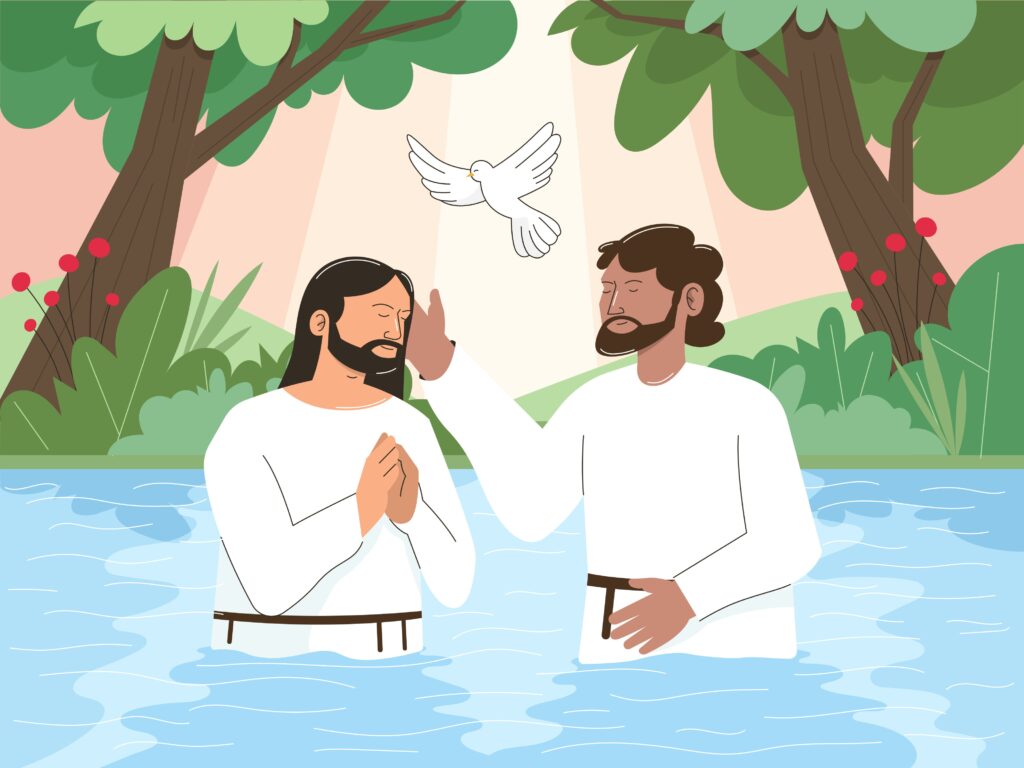
In all three synoptic gospels, Jesus’ ministry begins with his baptism, followed immediately by his confrontation with Satan in the wilderness. I suspect that by the time they wrote their gospels, they viewed all of Jesus’ life and ministry as a confrontation with Satan, so that was a fitting introduction.
In their wilderness confrontation, Jesus countered each of Satan’s challenges with truth from God’s word. I think the message for us to understand is that Jesus had come to destroy Satan’s kingdom, but his weapons wouldn’t be what anyone expected. Jesus’ weapons would be truth, prayer and God’s word, exactly what Paul later tells us to use to resist Satan.
John’s gospel is organized around pictures and their symbolic meanings, so he begins Jesus’ ministry with a miracle at a wedding. It’s a reminder of the importance of the marriage covenant as a picture of the relationship God wants with each of us. It’s a fitting beginning for his ministry, which will conclude with Jesus’ marriage proposal on the cross, arms outstretched, saying, as Greg Boyd interprets* it,
“This is who I am. I love You. Come to me and marry me!”
*(Greg Boyd, Twisted Scripture, Romans 9, YouTube)
In between those marriage bookends, Jesus’ ministry shows us who he and God are through a series of seven symbolic miracles, which John calls signs, and through seven “I Am” statements.
Jesus’ message and mission come into focus through both his miracles and his teaching: “The Kingdom of God is near!”
“The time promised by God has come at last!” he announced. “The Kingdom of God is near! Repent of your sins and believe the Good News!”
Mark 1:15 NLT
From then on Jesus began to preach, “Repent of your sins and turn to God, for the Kingdom of Heaven is near.”
Matthew 4:17 NLT
In Luke’s gospel, Jesus announced his mission and purpose immediately after his encounter with Satan in the wilderness.
He went to Nazareth, where he had been brought up, and on the Sabbath day he went into the synagogue, as was his custom. He stood up to read, and the scroll of the prophet Isaiah was handed to him. Unrolling it, he found the place where it is written: “The Spirit of the Lord is on me, because he has anointed me to proclaim good news to the poor. He has sent me to proclaim freedom for the prisoners and recovery of sight for the blind, to set the oppressed free, to proclaim the year of the Lord’s favor.” Then he rolled up the scroll, gave it back to the attendant and sat down. The eyes of everyone in the synagogue were fastened on him. He began by saying to them, “Today this scripture is fulfilled in your hearing.”
Luke 4:16-21 NIV
Jesus came to establish the kingdom of God. In both a literal and a figurative sense, he:
- Proclaimed good news for the poor,
- Proclaimed freedom for prisoners and the oppressed,
- Proclaimed recovery of sight for the blind,
- And proclaimed the year of the Lord’s favor.
Everything about Jesus’ ministry related to his mission – to show us the kingdom of God and the new covenant in action, and to invite us in. Jesus’ miracles are both literal and figurative pictures that bring the new covenant to life. In each miracle, Jesus is restoring a part of creation to health. The next topic includes a summary of his miracles.