Before Darwin, most people throughout the world believed that life looked designed because they believed it was designed. Then Darwin offered an explanation for the “appearance of design” based on his theory that all species change over time through a gradual process he called “descent with modification”.
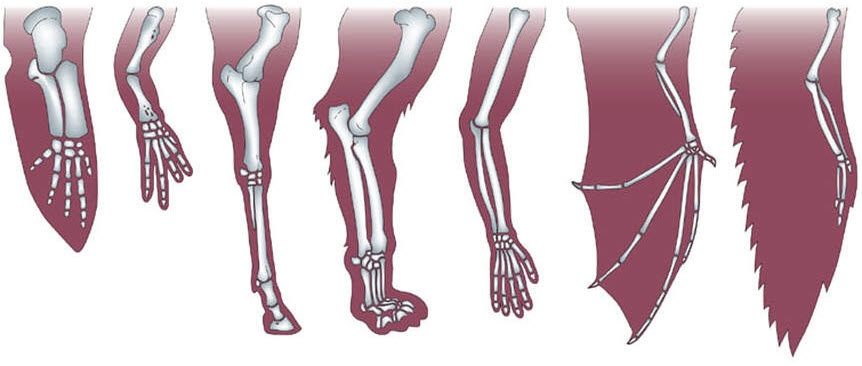
Descent with modification formed the cornerstone of Darwin’s theory of evolution. Scientists since the 16th century had noticed and studied the shared anatomical structures in different groups of animals. British scientist and Darwin contemporary Richard Owen named this “homology”, taken from the term analogy, and considered it evidence of a common “archetype” or body plan in the mind of the Creator.
But Darwin proposed that homology was a sign of shared ancestry, which he called descent with modification, and not a plan in the mind of a Creator.
Darwin then shifted his focus to what might have driven the process. He began with the idea that in any population, certain individuals were born with new and better abilities (a little stronger, a little faster, a little bit better at something). Darwin called these “chance variations”.
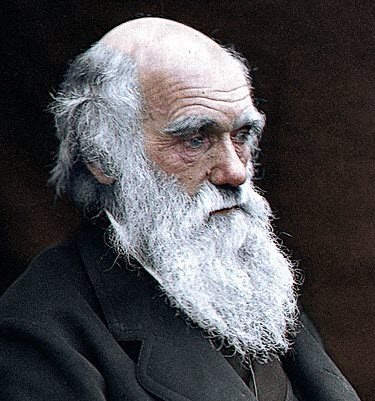
When those chance variations were beneficial to the organism, they would be more likely to survive and therefore more likely to reproduce. This would naturally lead to slow, steady improvement. Darwin called this “natural selection”.
Darwin was convinced that his theory of descent with modification, driven by natural selection, was the only possible way to explain the similarities of anatomy that were apparent among different groups of organisms.
Darwin lived at the peak of the Industrial Revolution, and continual progress was the expectation of the age. Natural selection appealed to their anticipation of constant progress. If natural selection captured and preserved every small improvement that came along, it made progress inevitable.
Darwin’s theory also came along toward the end of the Enlightenment period, with all its prevailing views and currents of thought. Methodological naturalism grew in popularity and took hold during the 1800’s. Sophisticated opinion began to reject anything supernatural. As Charles Dickens said, it was the age of reason, it was the age of foolishness.
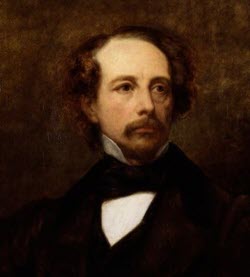
Used under Creative Commons license
“It was the best of times, it was the worst of times, it was the age of wisdom, it was the age of foolishness, it was the epoch of belief, it was the epoch of incredulity, it was the season of Light, it was the season of Darkness…”
A Tale of Two Cities by Charles Dickens
Notions related to evolution had been around since the ancient Greeks, but finally found traction during the Enlightenment. All evolution lacked, and had always lacked, was some process that could harness nature to make it happen. To many minds, Darwin supplied that missing process.
The time during which Darwin lived was important, but I think two personal experiences played larger roles in forming his ideas about evolution and creation. First, he came from a family of “freethinkers”; his grandfather, Erasmus Darwin, had been a prominent “transmutationist”, convinced that unaided nature, not God, had been responsible for Earth’s amazing diversity of plants and animals.
But I think the death of Darwin’s 10-year-old daughter Annie from scarlet fever affected his life, work, and faith more than anything else. Darwin was profoundly changed and struggled with her loss for the rest of his life. That’s something nobody can simply “get over and move on” from, and I think it probably pushed Darwin even farther toward scientific materialism and rethinking his relationship with God.
Design Without a Designer

Darwin offered the world “design without a Designer”, with natural selection taking the designer’s role. In a leap of faith, our world bought into it.
For anyone who was already drawn to materialism, this seemed to bring the question of origins out of the realm of religion and philosophy and into the world of science. And in many people’s minds, science automatically confers credibility.
Darwin’s theory is easy to grasp and that’s part of its appeal. As soon as you hear it, it seems intuitively obvious. Simple answers like evolution are especially attractive because they also help us convince ourselves that we understand more about the world than we actually do.
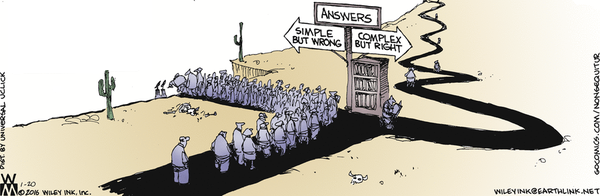
Evolution and natural selection are also easy concepts to generalize. And don’t forget that we’re storytellers by nature. People found they could explain almost anything about human nature by appealing to a story about our supposed evolutionary journey. So over the next few decades evolution found its way into most of the social sciences as well as into archaeology, paleontology, anthropology, geology, genetics, psychology, and much more.
Today, the Darwinian evolution story is endlessly repeated. From childhood on, we absorb it from National Geographic, PBS, schools, museums, and more. Evolution has grown deep roots into our culture. We easily mistake familiarity for truth, but Darwin’s simple answers don’t line up with either scientific or biblical truth.
Recommended Books:
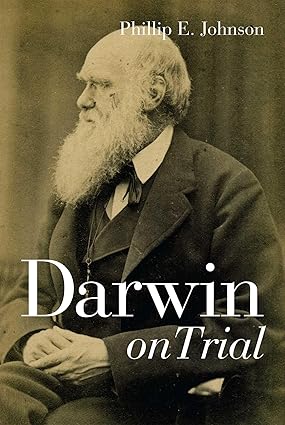
Darwin on Trial by Philip E. Johnson