Darwinian Evolution is presented as “settled science”, or as a consensus supported by overwhelming evidence, or as a fact of life that’s as well established as gravity.
Science is never “settled”, so calling anything “settled science” should invite scrutiny. It either means someone is hiding something, or it means “I can’t defend this so I’m just going to dismiss your questions”. The nature of science is to constantly check, confirm, and revise as necessary.
Evolution may be a consensus viewpoint, but not because it’s supported by overwhelming evidence. Mass conformity usually results when it’s being enforced, either subconsciously or by external forces.
And no, evolution isn’t as well established as gravity. When you investigate, you find the actual evidence for evolution is weak or non-existent. So, what’s the real status of evolution? Is it even a valid scientific theory? Or is it just a myth?
What is a theory? Here’s a good definition:
“A theory is a structured, evidence-based explanation for patterns, behaviors, or phenomena in the natural or social world. Developed through research and testing, theories organize facts, laws, and hypotheses into a coherent framework that explains “why” or “how” something happens, allowing for predictions and deeper understanding.”
A theory founded on observable evidence and expressed by mathematics can be tested and confirmed. But what about a theory like Darwinian evolution that’s based on philosophy and informal logic? I think we start by summarizing the assumptions and evidence that inspired it. There wasn’t much evidence, and even that was wrong. Common sense tells us if we start a journey in St. Louis, pointed east, and never correct our course, we won’t end up at the Pacific Ocean. By the same logic, a theory that emerges from mistaken assumptions and false evidence will never describe reality.
The assumptions and evidence that produce a theory set hard limits on the conclusions that are possible. A theory that emerges from mistaken assumptions and false evidence can never describe reality.
Here’s a concise summary of Darwin’s assumptions and supporting evidence.
Darwin’s Assumptions:
- He assumed that organisms are innately moldable, with no limit to the degree of anatomical change possible.
- He assumed that the mysterious hereditary mechanism that was enhancing desired traits for breeders could, given more time, also create completely new and novel traits.
- He assumed that evolution would create wonders, given enough time, by taking incremental steps and accumulating every small improvement.
Neo-Darwinists added their own:
- They assumed half of mutations were beneficial and half were detrimental.
- They assumed random, accidental mutations would create brand-new genes.
Darwin’s Evidence:
- Cells are simple building blocks made of protoplasm
- Haeckel’s Embryo Drawings
- Lamarck’s Theory of Continual Improvement
- Homology
- Fossils
Darwin founded his theory on bad assumptions and false evidence. I’ll go into detail below.
Darwin’s Hidden Assumptions:
Darwin probably wasn’t aware of the assumptions implicit in his theory; they were built into the way he viewed the natural world. But we can look at his theory and bring his assumptions out into the open.
1. Darwin assumed that organisms are innately moldable, with no limit to the degree of anatomical change possible.
He supposed that organisms could morph endlessly into new forms, that anatomy was pliable and easy to mold. We get a glimpse of that in this quote from Origin:
“I can see no difficulty in a race of bears being rendered by natural selection more and more aquatic in their structure and habits, with larger and larger mouths till a creature was produced as monstrous as a whale.”
It was easy for Darwin to imagine new features popping into existence just as if natural selection was molding Play-Doh. He didn’t know about genes or DNA, so he couldn’t have known that physical change would have to start with new information held in new genes.
As professor of biochemistry Michael Behe has said:
“Anatomy is, quite simply, irrelevant to the question of whether evolution could take place on the molecular level.”
Even today, nobody can tell us exactly what genetic changes would be required to morph one kind of animal into another, with a new body plan.
2. Darwin assumed that the mysterious hereditary mechanism that was enhancing desired traits for breeders could, given more time, also create new and novel traits.
Darwin was assuming that the factors that produced more milk in cows, or more wool in sheep could also do more, even to the point of developing into new kinds of animals.
Our immediate reaction should be “why would you assume that?” How could producing more of something an organism was already able to produce be expected to create something brand-new and completely different, just given more time?
Today, molecular biology knows that the enhancements breeders achieve are the result of reshuffling genes that already exist in the gene pool. On the surface, things may look new; some cosmetic changes are dramatic. But no new genes are ever created, and no species boundaries are ever crossed. In all the centuries of breeding dogs, no new species has ever been developed; all varieties of dogs can still interbreed.
3. Darwin assumed that evolution would create wonders, given enough time, by taking incremental steps and accumulating every small improvement.
In Origin, Darwin wrote:
“If it could be demonstrated that any complex organ existed, which could not possibly have been formed by numerous, successive, slight modifications, my theory would absolutely break down.”
He immediately added that to his knowledge, there were no such examples.
The idea that nature could replace a Designer by breaking a complex process down into achievable steps is appealing. In “Climbing Mount Improbable”, Richard Dawkins compared evolution to a mountain with a sheer face on one side, but on the back side, a gradual incline with small steps leading to the summit.
He was trying to illustrate Darwin’s claim that natural selection can create new animals through the cumulative effect of many small steps over a long period of time. To our intuition, it seems like natural selection could tame the odds and make evolution inevitable, just by breaking it into manageable bits.
This assumes that the process of morphing one animal into another is simple enough to be divided into a linear sequence of small steps. Further, it assumes the next beneficial step (Darwin’s slight modification) is always possible and always attainable. But what if that next small step can only be done by means of five or more even smaller steps before it’s a benefit?

British engineer, author, and professor of engineering design, Stuart Burgess has said:
“The most severe constraint on evolution is that of incremental change, which prevents it from producing systems that require many parts to originate simultaneously.”
The principal tenet of Darwin’s theory is that a “variation” must be beneficial. If it doesn’t benefit the organism, then natural selection won’t preserve it and it will quickly disappear. In practice this means that evolution can’t produce anything that needs multiple parts. This isn’t just a “speedbump” for evolution. It’s an impasse, since life is almost entirely composed of entities with many interacting parts. This is true at both the cellular level and the organism level:
- The molecular machines inside cells are made from up to 50 different proteins. But those protein components are of no value by themselves. The machine must be complete and functioning to maintain life.
- The organs in our bodies are collections of multi-part systems. By themselves, individual organs and components can’t sustain themselves and can’t provide any benefit.
In living systems, one component at a time doesn’t work. Organisms can’t afford to wait patiently for natural selection to deliver all the systems that are critical to maintain life. If natural selection had foresight, it could hold onto functionless parts until they could be built into something functional. But only a mind has foresight.
Neo-Darwinists added more assumptions:
Neo-Darwinists thought mutations were the missing mechanism for large scale evolution. However, they adopted mutations before anyone knew much about them. Their ready acceptance of mutations was predicated on two related assumptions.
1. They assumed half of all mutations are beneficial and half are detrimental
Sir Ronald Fisher was a British mathematician who helped found the new fields of quantitative genetics and population genetics. He was a convinced atheist and evolutionist. His work on population genetics played a major role in establishing Neo-Darwinian theory.
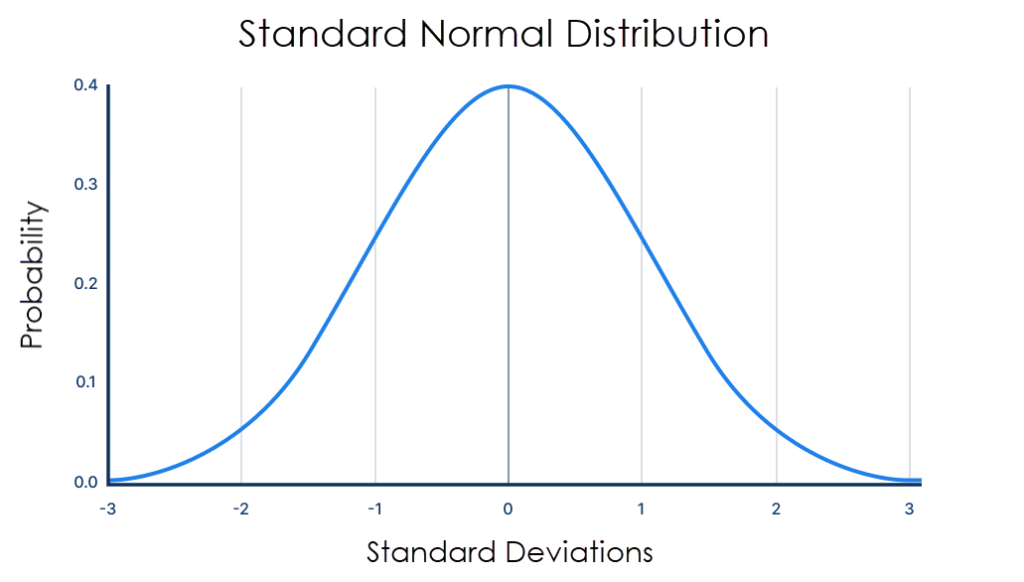
Fisher developed population genetics in the 1920’s and 1930’s, before the actual nature of mutations was understood. His work was mathematically brilliant but he based it on an assumption that about half of all mutations would be beneficial to an organism, with the other half detrimental.
Today, experiments show that the effect of a mutation can’t be plotted on a normal distribution curve with detrimental on the left side and beneficial on the right. The scale for mutations only stretches from detrimental to neutral. Beneficial mutations are too rare to be important statistically.
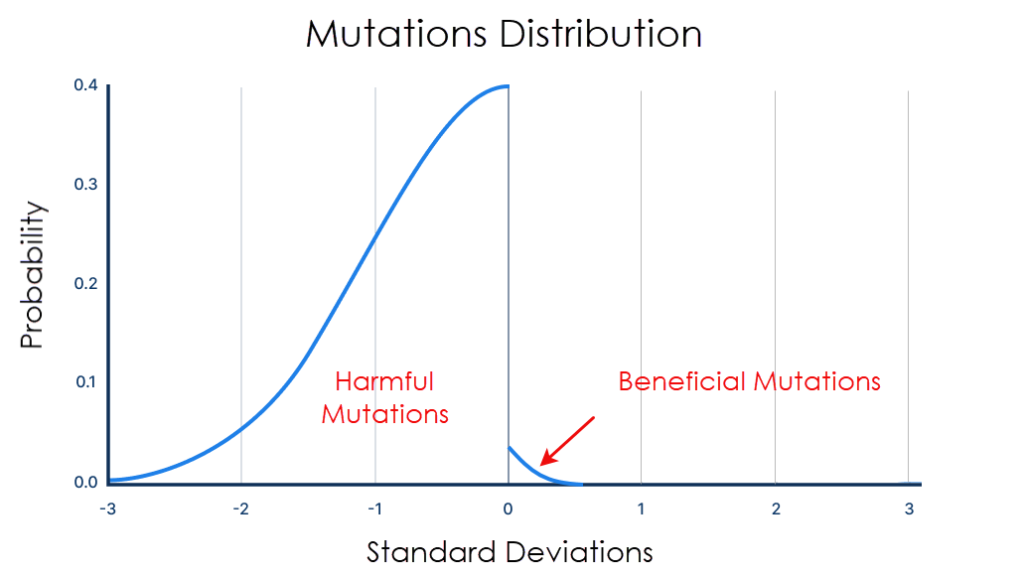
2. They assumed random, accidental mutations would create brand-new genes.
Neo-Darwinists settled on mutations as the agent that could function as a Designer substitute, delivering “bacteria to man” macro-evolution. It was the only mechanism available to their worldview.
Years of experimental evidence have proven that real-world mutations have no creative ability. Today, we know that it requires multiple coordinated mutations to modify just one existing protein in any beneficial way. To create brand-new proteins, new organs and structures, and new animals through a long series of accidental mutations is a pipe dream.
Darwin’s Supporting Evidence:
We already introduced most of the following ideas in the topic Darwin’s World, but now we’ll consider their flaws.
1. Cells are simple building blocks made from protoplasm:
This one may have led Darwin farthest from the truth. He thought cells were all made from the same stuff, and were more or less interchangeable. So they should be easy to rearrange into something else. Now we know that cells are made from thousands of tiny molecular machines, not protoplasm, and specialized for their particular purpose.
2. Haeckel’s Embryo Drawings:
Darwin wrote to a friend that he considered Haeckel’s embryos to be the strongest evidence in favor of his theory. Whether intentionally or unconsciously, Haeckel’s drawings were massaged to make them support his theory that embryos replay their evolutionary history. It wasn’t until 1997 that anyone attempted to confirm Haeckel’s theory.
Today, Haeckel’s theory and his drawings have been refuted. Embryos do not replay their “evolutionary history”. His drawings have finally been removed from most current textbooks, but the concept is still popular, just reworded and accompanied by new drawings. It’s fiction, but too many people think it’s true.
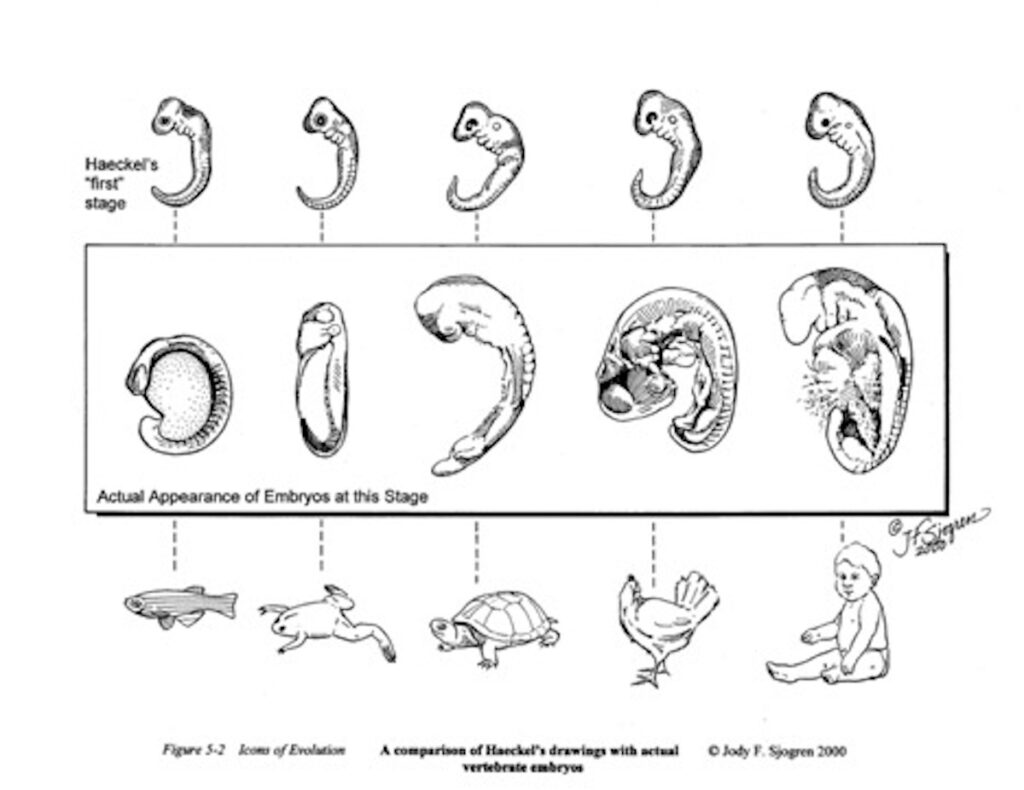
Embryology doesn’t resemble what Darwin or Haeckel thought. The development of an embryo is much more complex – it follows a carefully orchestrated path. Keeping the embryo alive through every stage from single cell to newborn depends on precise sequence and timing. Science has progressed way beyond Haeckel’s clever but simplistic stories.
3. Lamarck’s Theory of Continual Improvement
Darwin accepted Lamarck’s theory that any change during an organism’s lifetime could be passed along to offspring. But today we know that we’re all born with genes chosen from the pool our parents were born with. Nothing they might have developed during their lives affects their egg or sperm cells.

4. Homology
People had observed the similarities of anatomy between different animals since antiquity. It was considered an “archetype” of design shared across species. Leading British anatomist Richard Owen coined the term homology to describe it.
But when Darwin observed those similarities, he postulated that animals or plants that possess similar structures must have descended from a common ancestor at some point in the past. This was an assumption, not supported by evidence. He then proceeded as if common descent was a proven fact and made it the centerpiece of his theory.
When Origin was published, most scientists objected that similarities in physiological structure didn’t necessarily imply a common ancestor. In 1871, St. George Mivart published On the Genesis of Species, explaining that such an inference involved circular reasoning. “Similarities of bodily structure were assumed to be indications of common descent without actual evidence; then those similar structures were taken as evidence for common descent.”
Circular reasoning can be difficult to detect; it’s an argument that comes back to its beginning without having proven anything. For example, Darwin’s reasoning in Origin was this:
Premise: Similar structures (homologies) exist because of common ancestry.
Evidence: We observe similar structures.
Conclusion: Therefore, common ancestry is proven by the similar structures.
Beyond the circularity of reasoning, this ignores an obvious explanation – that a designer used similar structures to perform similar functions, just as an engineer uses similar parts in a variety of machines.
5. Fossils
Darwin’s view of the fossil record in his day was that it showed a trend from simpler organisms in the remote past to more complex today. From that limited perspective, the fossil record does show simple organisms at the beginning and more complex organisms later.
“Hence, we can understand the rule that the most ancient fossils differ most from existing forms.”
Darwin, Charles. The Origin of Species (p. 14).
But he also knew that when you look closely, the fossil record was a problem for his theory. It didn’t show the gradual change his theory demanded. He blamed that on its incompleteness. But today, with an exponentially greater number of fossils found, the record still contradicts gradual change.
- New animals appear abruptly, remain essentially unchanged for millions of years, then go extinct just as abruptly.
- In a “geological eye-blink” called the Cambrian Explosion, life took an exponential leap in complexity from single-celled organisms to animals.
- Fossils that could be considered transitions between different groups are rare and open to debate.
Even Darwin wondered, if organisms were always in the process of change and improvement, why were transitional fossils so rare and open to debate? He had expected them to be the primary feature of the record.
“… why is not every geological formation charged with such links? Why does not every collection of fossil remains afford plain evidence of the gradation and mutation of the forms of life? We meet with no such evidence, and this is the most obvious and forcible of the many objections which may be urged against my theory.”
Darwin, Charles. The Origin of Species (p. 72).
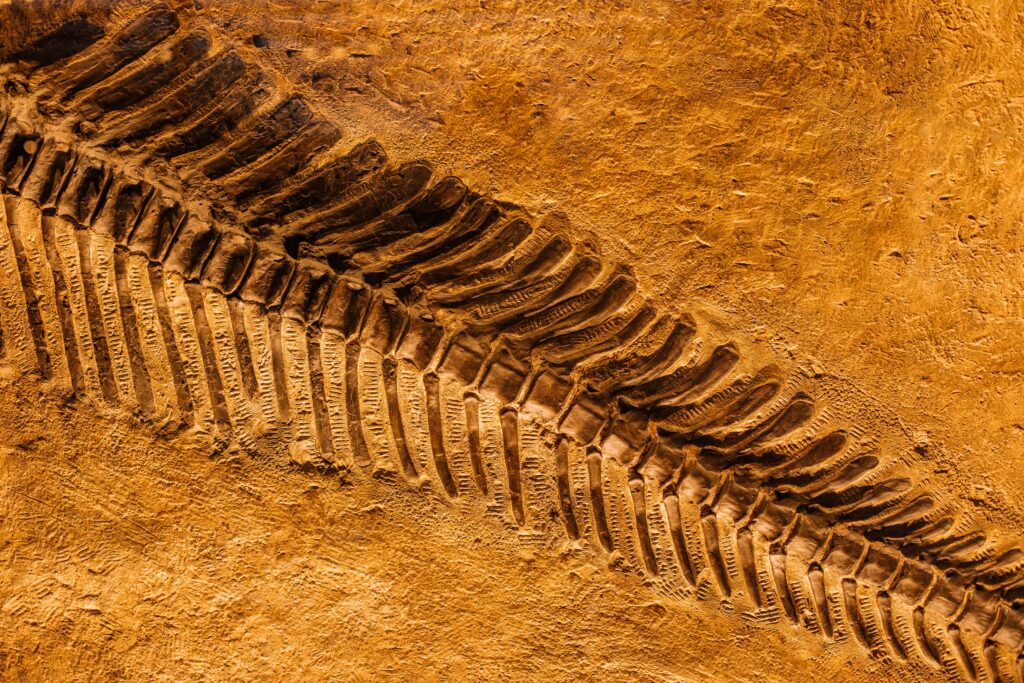
Though most people today assume fossils prove evolution, a closer look actually shows the opposite of Darwin’s gradual, directional change.
New groups of organisms appear in the fossil record suddenly, without precursors, then change very little for millions of years and finally go extinct.
In summary, what Darwin assumed about living things was wrong. Science hadn’t yet reached the point of understanding enough about life. The “science” he thought confirmed his theory was only uninformed speculation.
Evolution makes extraordinary claims about who we are. But extraordinary claims demand extraordinary evidence. Darwinian evolution doesn’t have it. The scientific evidence they claim as support is weak, debatable, or nonexistent.
That hasn’t daunted the naturalistic evolution enterprise. It’s still taught in schools and colleges. It’s still accepted truth in media. It’s promoted in every natural history museum, and most scientists are still expected to genuflect toward Darwin, whether they believe it or not.
So, why is Darwinian evolution still dominant in our culture?