According to the terms of Neo-Darwinian theory, natural selection has to wait on chance genetic mutations that are “just right” before it comes into play. Chance isn’t a good foundation for scientific theories, so Darwin worked to make natural selection the hero of his evolution story.
“It may be said that natural selection is daily and hourly scrutinizing, throughout the world, every variation, even the slightest; rejecting that which is bad, preserving and adding up all that is good.”
Natural selection hasn’t turned out to be the tireless workhorse they hoped it would be. In practice, nature sees the total package, the end result of thousands of different genes blending together to produce all the traits that make up an organism. Unless the effect of a mutation is catastrophic (severely damaging, or fatal), its actual influence on reproductive success is miniscule.
The limit that reality imposes on natural selection shifts the focus of the theory back to Darwin’s “beneficial variations”. Neo-Darwinism tied variations to accidental mutations, and nothing else. So, evolution is basically a conviction that errors have creative power. Does this work anywhere else in life? We all know it’s easy to break things accidentally. But I’m pretty certain nothing amazing has ever been built by accident.
Evolutionists credit mutations as the basis of the most ingenious inventions the world has ever witnessed: new traits, new organs, and new animals. Can accidental mutations really produce new organisms or are they just accidents that degrade things that already exist?
Experience and Common-Sense Weigh In
The trillions of cells in our bodies divide many times during our lifetime. Even though the mutation rate is very low, mutations add up. We call it aging. By the time you die of old age, your body will have accumulated billions of mutated cells. Not one of them will have done you any good at all.
We also know that mutations lead to cancer, which often leads to death. In the real world, mutations can be dangerous; they’re never helpful.
Experimental Science Weighs In
When Neo-Darwinism replaced Darwin’s vaguely defined “chance variations” with random mutations, scientists finally had real entities they could study. Science has since learned a great deal about mutations.
After 60 years of dosing fruit flies with radiation to increase their mutation rate, there is no evidence that any fruit fly mutations have creatednew, beneficial structures. Mutations have produced crumpled wings, oversized and undersized wings, and double sets of wings (but one set has no muscles attached). Experiments have provided lots of examples of bizarre changes, like a leg growing where there should have been an antenna.
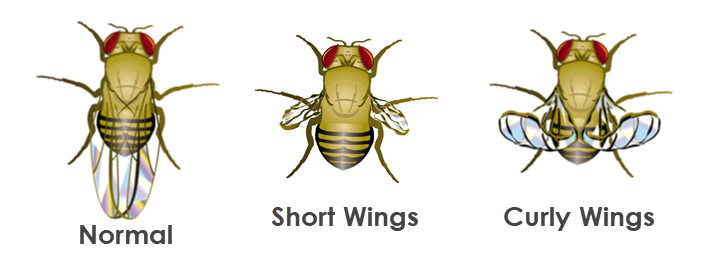
In all that time, no mutation has ever created an improved function or transformed the fruit fly into a new kind of insect. They have only damaged existing structures. Experience shows us that mutating the DNA of a fruit fly embryo leads to one of three possible outcomes: a normal fruit fly, a defective fruit fly, or a dead fruit fly.
Experiments done more recently, with the aid of genome sequencing, identify the underlying cause. Mutations that affect portions of the genome involved in the early stages of development of an embryo, while it’s establishing the basic body plan and developing primary organs, are invariably fatal. Mutations occurring later in development are bizarre, but usually not fatal.
Something’s Wrong With This Picture
Yes, there’s something wrong with this picture. Biologist Lynn Margulis, along with many others, realized Darwinism didn’t add up. As an atheist, she was looking for an updated theory that didn’t imply a Creator. This quote illustrates the thinking of many biologists:
“New mutations don’t create new species; they create offspring that are impaired. Neo-Darwinists say that new species emerge when mutations occur and modify an organism. I was taught over and over again that the accumulation of random mutations led to evolutionary change – led to new species. I believed it until I looked for evidence.” – Biologist Lynn Margulis
To understand why mutations don’t lead to new species, we only need to know more about what mutations are and what they can do.
Mutations:
Mutations are errors that can happen when DNA is copied. So we need to know a bit about how DNA gets read and copied before we can study mutations in more depth.
We know less about DNA than you would think from watching crime shows. Most of it has purposes we don’t understand yet. The parts we understand best are genes; each gene holds the recipe for the sequence of amino acids that form one particular family of proteins.
The following definitions are intended to get us all on the “same page”, ready to look into mutations.
Genes:
A gene is a short section of DNA that holds instructions for building one specific protein. (They’re only short compared to the length of DNA. Most genes are more than 600 nucleotides in length.) Genes only account for 2-3% of our genome. The rest of our DNA used to be considered “junk” left over from millions of years of evolution and it was ignored by scientists until 2012. More about junk DNA later.
The DNA Double Helix:
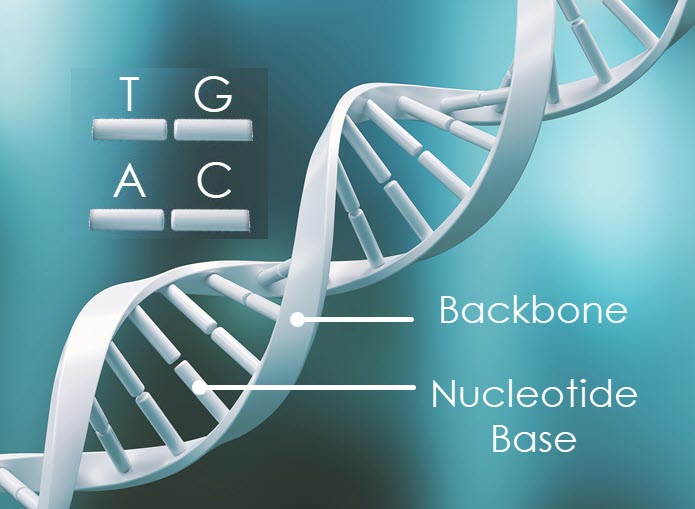
DNA is made from two very long chains of nucleotides, twisted together in the familiar double helix ladder configuration.
Chemically, a nucleotide is made up of three parts. Phosphate and sugar molecules form the backbone. and a nitrogenous base molecule forms one half of a rung of the ladder.
Nucleotides:
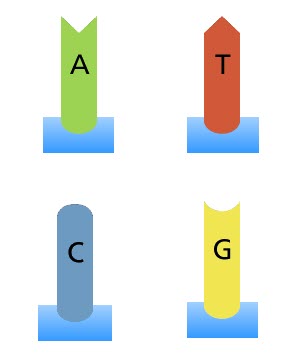
The base can be any one of four molecules: adenine (A), thymine(T), cytosine(C), and guanine(G). Initials are used in place of their chemical names, so the four nucleotides are called A, T, C, and G.
Base A bonds naturally with T, but not with any others, so A and T are called complementary pairs. Bases C and G work in the same way. You can think of these like nuts and bolts, with one pair metric threads, the other imperial. Since we’re more interested in the logic of how DNA works to hold information than its chemistry, we’ll represent nucleotides with the symbols on the right.
DNA Alphabet:
We’re ready to look at the ingenious method that DNA uses to store, copy, and supply information to build proteins. The four base pairs in DNA make up a four-letter alphabet, used to specify amino acids in proteins. Evolutionists say DNA is just a “simple code”, since it’s based on just a 4-letter alphabet. This is like calling a computer a simple device because it operates with just two numbers, zero and one.
Proteins
A protein is built from a long chain of amino acids, which is then folded into its unique 3D shape. The shape of proteins is a big part of what makes them function. Each one is built from a very specific sequence of twenty different amino acids that are useful for life. A typical protein is about 200 amino acids in length. The recipe for the right sequence for each particular protein is encoded in DNA.
Codons
Written languages start with an alphabet, letters build words, and words build sentences that convey meaning. DNA follows a similar pattern.
Molecular machines locate the portion of DNA that holds the recipe for a protein. Another machine reads the sequence of nucleotides (the letters) in groups of three, called codons (the word). Codons are always three letters long, and for a good reason. Using an alphabet of 4 letters, you can make 64 different three letter Codons. (You can choose from 4 possible letters for each position, so that’s 4 x 4 x 4 = 64.)
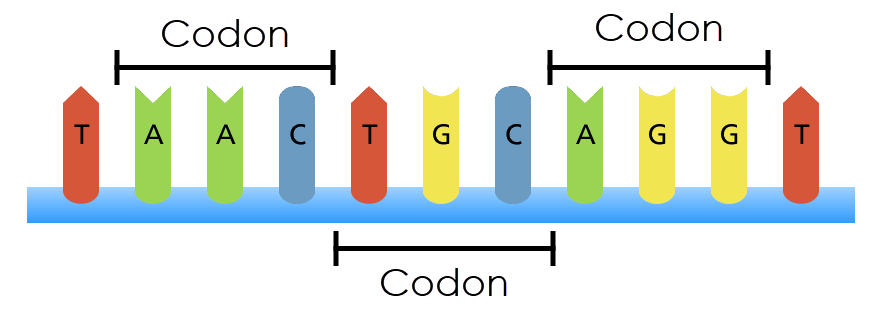
Cells need to use and identify 20 different amino acids, plus start and stop signals, so the minimum number of “words” needed is 22. Three letters are ideal, and this also allows for redundancy (a very desirable goal in design). With 64 words available to call out 22 items, most amino acids have two or more names.
Mutations: What Can Go Wrong?
So, what can go wrong when a cell is copying DNA? There are four possible types of errors:
- Single Point Substitutions (Here, we substituted a C for the original T.)
- Insertions (We inserted a C, so the remaining nucleotides shifted to make space.)
- Deletions (We deleted a T, so the remaining nucleotides shifted to close the gap.)
- Duplications (These act like group Insertions.)
For illustration purposes, we’re going to change from using DNA letters and amino acids to English letters and words to show you the effect of each type of mutation.
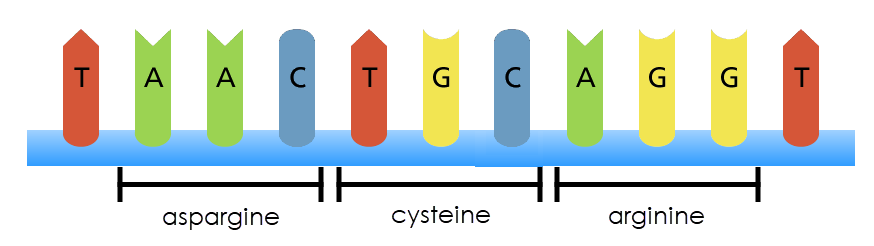
Substitution Mutations
Substituting one single nucleotide for another is the most common mutation. It can be a:
Mis-Sense Mutation:
This is a change in one DNA nucleotide that results in the substitution of one amino acid for another in the protein.
What fools these mortals be. -> What foods these mortals be.
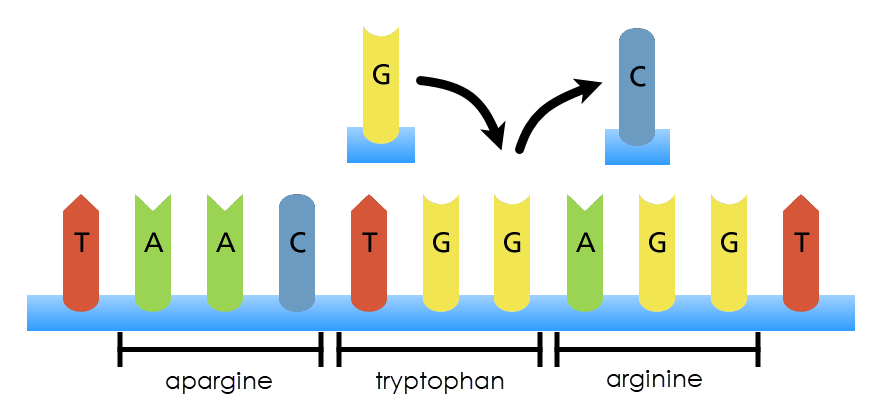
Non-Sense Mutation:
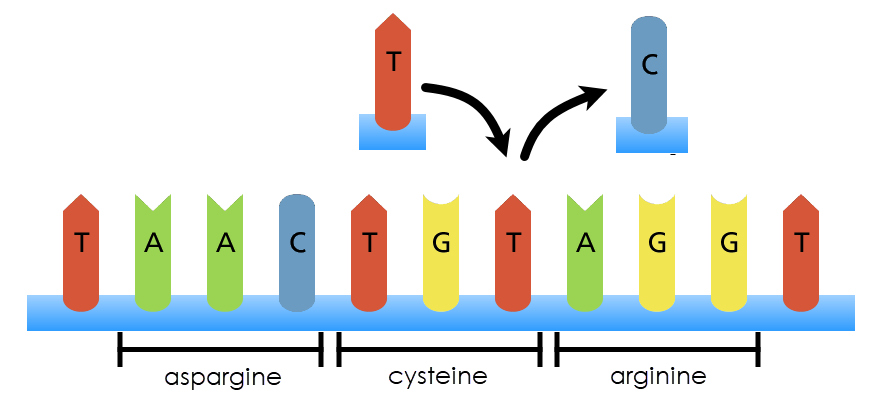
A non-sense mutation is also a change in one nucleotide. Instead of substituting one amino acid for another, however, the mutation changes it into a stop signal. This results in a shortened protein that won’t function at all.
What fools these mortals be. -> What foo.
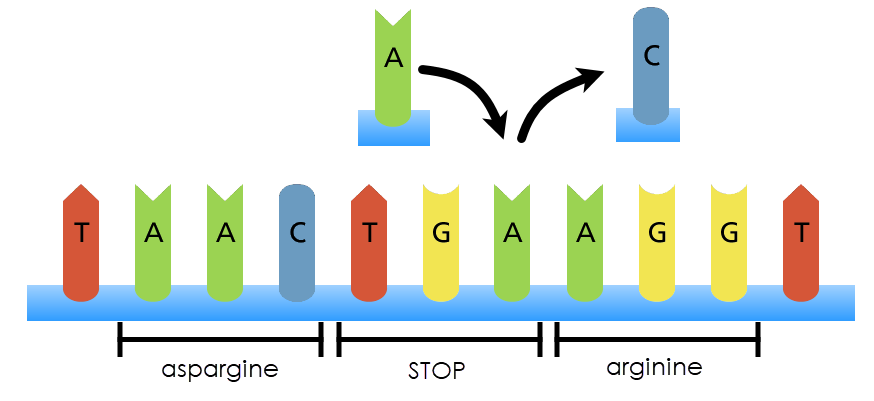
Neutral Mutation:
Since most amino acids are specified by more than one code, it’s sometimes possible to substitute one nucleotide for another that codes for the same amino acid.
What fools these mortals be. (remains) What fools these mortals be.
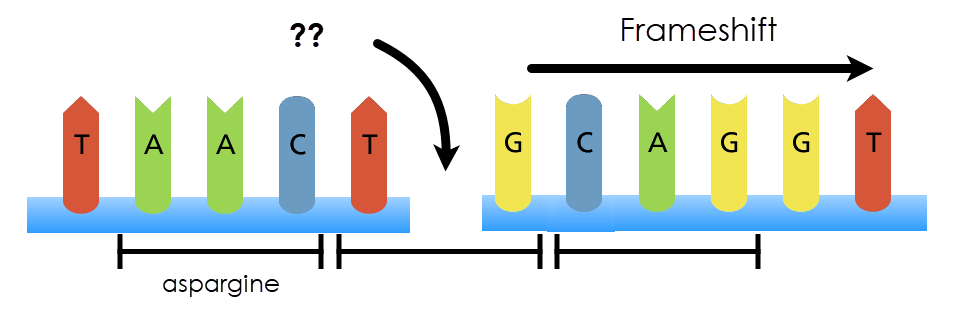
Frameshift Mutations
Since DNA is always read in groups of three nucleotides, an insertion or deletion shifts the reading frame so the downstream sequence is completely different. A frameshift results in a protein that is almost always nonfunctional. Here it is with English letters:
Dog ran but cat sat. -> Dog ran sbu tca tsa
We inserted one letter, but keeping the 3-letter divisions, it no longer has meaning.
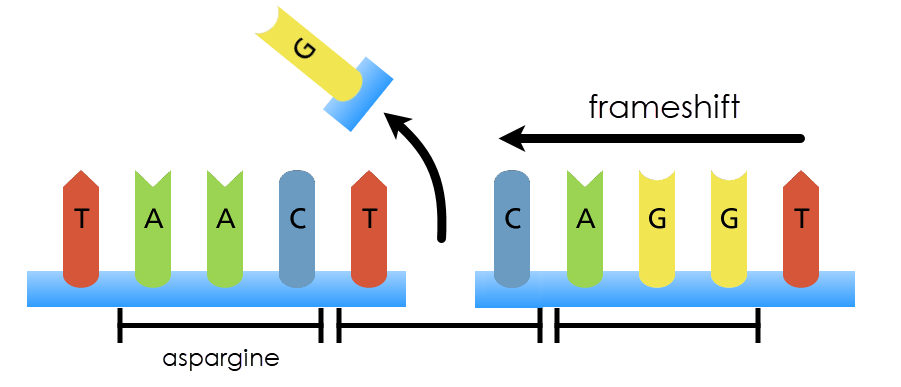
In a similar way, we can delete a letter.
Dog ran but cat sat. -> Dog ran utc ats at.
Nonsense again.
Or we can duplicate several letters.
Dog ran but cat sat. -> Dog ran but cat but cat sat sat.
Again, nonsense.
Evolutionists claim that the first step toward a brand-new gene is to duplicate an entire gene or even an entire chromosome. They assume this gives the cell an extra copy to tinker with, without damaging the existing gene. But if you look up duplication in the medical literature, all you’ll find are references to the diseases caused by gene duplication. So, while evolutionists assume this gives them a copy that’s safe to modify, that isn’t true in practice.
And now you know what mutations actually do. There are no “magical” mutations we didn’t tell you about. Common sense tells us it would be very easy for random mutations to break an existing gene, but very unlikely to create a brand-new gene.
The more we learn about mutations, the less they look like the creative force for evolution. Over the past 60 years, both experience and experimental science have repeatedly confirmed this. Accidental mutations don’t have the creative power evolutionists needed them to have. It takes more than one single mutation to produce any measurable effect at all. It would take many very specific mutations to generate even a simple new capability. In the real world, mutations just damage existing genes.
In 2019, Michael Behe published Darwin Devolves. It explains what gene sequencing has already revealed about mutations, adaptation, and micro-evolution. Here’s Behe’s conclusion:
“We never find any evidence that mutations have created new genes. What we do find are minor modifications to genes that already existed. It’s much harder to build a new gene than to break an existing gene.”
It isn’t uncommon for mutations that are technically either neutral or damaging to produce what’s known as micro-evolution, helpful adaptations. Polar bears resulted from two mutations that weren’t beneficial by themselves. One mutation stopped the production of melanin, resulting in white fur replacing the original brown. The other accidentally allowed polar bears to survive on a high fat diet of seal blubber. Together, these mutations made polar bears uniquely fit for life in the arctic.
Those mutations didn’t build any new genes; they just destroyed existing genes and their functions. Slowly eliminating more and more genes won’t gradually build a new animal. New animals require new genes.
Where does this leave Darwinian evolution? If random mutations can’t produce new animals, where are evolutionists looking for a mechanism for major change?
At least fifteen years ago, their focus shifted to the newer field of Evolutionary Development (evo-devo) and to developmental Gene Regulatory Networks (dGRN). DGRNs orchestrate the assembly of body plans during embryonic development. They’re assuming (or hoping) that just a few key mutations in the gene regulatory networks that orchestrate embryo development might produce a new body plan. This would bypass the need for thousands of specific mutations in the rest of the genome.
What they are learning is that the complexity of GRNs is mind-boggling. Nothing anyone has learned implies evolution, or any other cause. Understanding how something works doesn’t tell you anything about how it came to exist.
Our daughter and son-in-law ran across an example of this new direction recently at the Harvard Museum of Natural History.
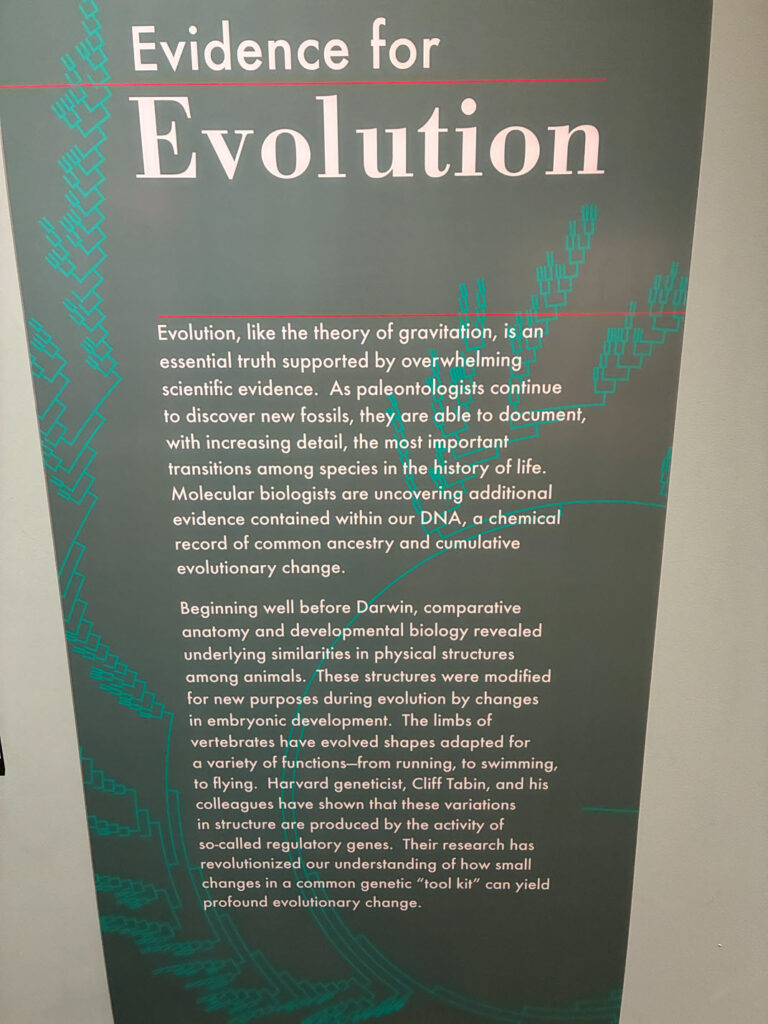
“Beginning well before Darwin, comparative anatomy and developmental biology revealed underlying similarities in physical structures among animals. These structures were modified for new purposes during evolution by changes in embryonic development. The limbs of vertebrates have evolved shapes adapted for a variety of functions – from running, to swimming, to flying…
… Harvard geneticist, Cliff Tabin, and his colleagues have shown that these variations in structure are produced by the activity of so-called regulatory genes. Their research has revolutionized our understanding of how small changes in a common genetic ‘tool kit’ can yield profound evolutionary change.”
Stating that structures evolved through changes in embryonic development is a false assumption without evidence. It’s putting an evolutionary gloss on evidence. It contradicts all the experimental evidence generated by 60 years of experiments.
While it may be true that “variations in structure are produced by the activity of regulatory genes”, that doesn’t say anything about the origin of either anatomical structures or regulatory genes. Stating that structures evolved through changes in embryonic development is a false assumption without evidence. It’s putting and evolutionary gloss on a discovery that doesn’t touch on evolution. And it contradicts all the evidence generated by sixty years of research.
Cliff Tabin and his lab are studying how regulatory genes affect the development of limbs. His field of developmental biology studies the processes by which organisms develop from a single cell into a complex multicellular organism.
What the Harvard sign doesn’t say is that mutation experiments over the past sixty years prove that if a mutation affects a regulatory gene, the organism dies before birth. Too many processes downstream are thrown out of whack by any change in regulatory genes.
Stephen Meyer discussed evo-devo in his book Darwin’s Doubt:
“The system of gene regulation that controls animal-body-plan development is exquisitely integrated, so that significant alterations in these gene regulatory networks inevitably damage or destroy the developing animal.”
Meyer, Stephen C.. Darwin’s Doubt: The Explosive Origin of Animal Life and the Case for Intelligent Design (p. 269). Kindle Edition.
Eric Davidson was a developmental biologist at Caltech. He was an expert in the field of evo-devo, and his work showed that mutations in the genes that affect body plans don’t lead to new animals, only to dead embryos. In his own words:
“There is a high penalty to change [in dGRNs], in that interference with the dynamic expression of any one of the genes causes the collapse of expression of all, and the total loss from the system of their contributions to the regulatory state … there is always an observable consequence if a dGRN subcircuit is interrupted. Since these consequences are always catastrophically bad, flexibility is minimal, and since the subcircuits are all interconnected, the whole network partakes of the quality that there is only one way for things to work. And indeed the embryos of each species develop in only one way.”
Engineers, designers, and builders know why mutations in the earliest stages of embryo development won’t produce a new animal. A change to the foundation imposes a chain of complementary changes to every system that touches or depends on that foundation.
If you change the foundation of a house, you’ll also have to make changes to walls, roof, plumbing, electrical, windows, heating, cabinets – pretty much everything. If you make a change to the operating system of a computer, every downstream function will have to be altered to work with it. If you change the size of an engine block, everything that depends on it will have to change.
This observation is universally true in the real world. Evolutionary biologists need to get out into that world more often.
Books to Recommend:
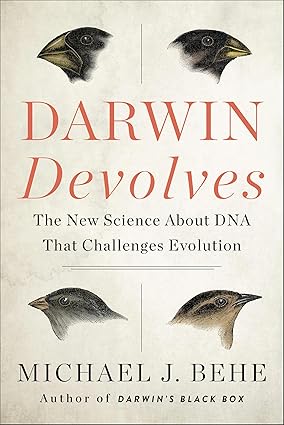
Darwin Devolves
by Michael Behe