At the start of the 20th century, scientists still knew very little about how heredity works. I’ll quickly trace the history of their discoveries next.
Gregor Mendel
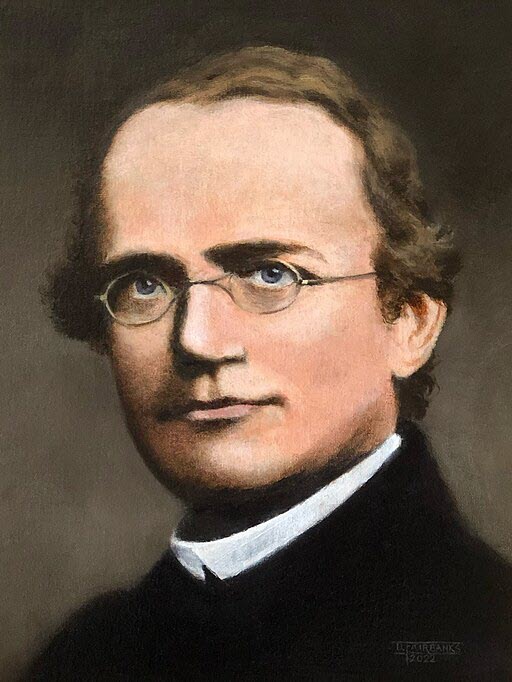
Gregor Mendel is well known today as the father of modern genetics. He experimented with peas in his garden and discovered and documented many of the rules of heredity that are still valid today. Even though Mendel had published the results of his experiments in 1866, the scientific world didn’t notice their significance until the 20th century.
Gregor Mendel is well known today as the father of modern genetics. He experimented with peas in his garden and discovered and documented many of the rules of heredity that are still valid today. Even though Mendel had published the results of his experiments in 1866, the scientific world didn’t notice their significance until the 20th century.
In his work he discovered the existence of inheritable elements that we now call genes. Darwinists were taken by surprise. Mendel had found that the genes that are inherited always come from the same pool of possibilities, generation after generation. And they appear in predictable, repeatable patterns.
This was a problem for Darwin’s theory. Darwin had assumed, without evidence, that certain individuals were born in every generation with new, unique, and heritable abilities. Mendel’s experimental evidence showed the opposite, that each generation is born with a unique subset of traits that already existed in the population pool. Darwin’s theory was about building brand-new animals, not just new variations around the same theme. You can’t do that from a fixed set of existing traits; in Mendel’s terminology, you can’t build a new animal without new genes.
If evolution was ever going to build new organs and new animals, it needed a mechanism that could produce new genes. Reshuffling existing genes could never produce anything beyond cosmetic change or tiny functional improvements, no matter how much time it had. Darwinism was in trouble and needed an update to make it compatible with Mendel’s genetics. Darwinists needed a mechanism that could create new genes.
Mutations
The word “transmutation” came into use in the 14th century, in association with alchemy. It was based on the Latin word “transmutare”, which meant to change from one condition to another. Alchemists were attempting to change less expensive metals into gold. 18th century naturalists who imagined that the living world had gradually changed from simple into more complex forms adopted the word and called themselves “transmutationists”. Darwin’s grandfather Erasmus was among them.
The shorter term “mutation” was first used in 1900, by Dutch botanist Hugo de Vries when he published The Mutation Theory, based on his observation that Evening Primroses sometimes exhibited spontaneous changes in form. He coined the terms mutation and pangenes, which was later shortened to “genes”. At that time, mutation simply meant “some genetic change” of unknown origin. DeVries proposed that evolution occurred by large, discontinuous leaps, as opposed to Darwin’s gradual variations. Years later, his examples were found to be due to unusual genetics in the primrose
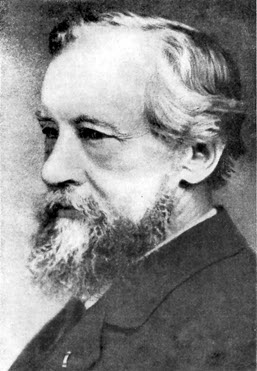
Over the next few decades, scientists gained more knowledge about heredity and mutations. In the late 1920’s Hermann Muller showed that X-rays could trigger mutations that produced bizarre changes in fruit flies.
By the 1930’s, biologists had seen cell division and mitosis. Here’s a short clip of mitosis, showing chromosomes doubling and dividing.
By the 1940’s scientists had established that chromosomes must be involved in heredity in some way and that the chemical DNA was carrying genetic information. In 1951 Fred Sanger sequenced the protein insulin, which opened fresh insights into proteins and their structure. Up to that time, scientists had known that different proteins were composed of differing amounts of 20 amino acids. Now it turned out that proteins were constructed not from just different amounts but from specific sequences of amino acids. Sanger was awarded a Nobel prize for his discovery.
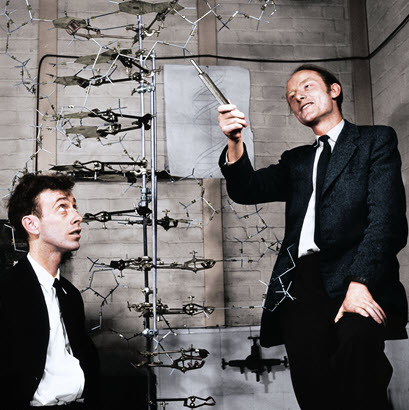
Then, in 1953, molecular biologists James Watson and Francis Crick cracked the mystery of the physical structure of DNA molecules. It was completely different than anyone had imagined. Crick had been a codebreaker during WWII, so it didn’t take him long to realize that the chemical components of DNA, called nucleotides, were functioning exactly like letters in written text.
Until then, scientists had supposed that the chemical properties of DNA were somehow responsible for its genetic function. But heredity turned out to be digital in nature, not chemical, coded in a language specified by the order of four DNA bases that formed a four-character digital alphabet. The chemical properties of DNA don’t play any role in heredity.
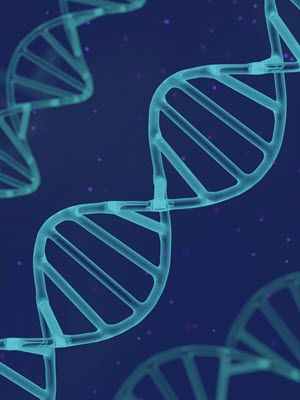
By that time, scientists had observed that errors sometimes occurred in chromosomes during cell division. Now, they realized that those copying errors might be the source for a change in the sequence of a DNA molecule. This convinced Darwinists that they had finally found an agent for change that could account for Darwin’s “chance variations”.
So, by the late 1950’s, biologists had converged on what is called Neo-Darwinism, also called the modern synthesis. Neo-Darwinists adopted the ideas that:
- Darwin’s “chance variations” were mutations, copying errors made in chromosomes during cell division.
- Mutations, followed by natural selection, must be the driving force of evolution.
Today, Neo-Darwinism is usually stated:
Mutations produce variations, which are the raw material for natural selection.
By the time of the 1959 Centennial of Darwin’s Origin, Darwinists were convinced they had explained evolution, and now there were just some details left to fill in.
Darwin gave the world a simple, superficially elegant theory that seemed to explain the appearance of design, but without a Designer. His theory is easily grasped, and it seems to answer one of the biggest questions of life, even if the answer isn’t very satisfying. Today it’s considered “settled science”.