Knowledgeable scientists and naturalists at the time dismissed Darwin’s conclusions, and with good reason. Their general reaction was that chance, even with a natural selection filter, was unequal to the task of generating the entire spectrum of life. Origin was built on armchair philosophy and speculation, but had no hard evidence to back it up. Proposing that new species might have come about by chance variation and natural selection wasn’t evidence that it did.
General Objections:
Experts in animal breeding responded that artificial selection wasn’t a good model for large scale change. Humans had been breeding dogs and other domestic animals for thousands of years, but had never created a new species, much less any skeletal or organ changes.

Selection only operated within limits and animals always reverted to the “root stock” when allowed to breed freely.
Scientists familiar with fossils noted that the fossil record didn’t display gradual change. What they consistently found was the abrupt introduction of new groups, with an almost complete absence of transitional fossils. If natural selection was continually introducing variations, where was the evidence in the geological record?
Darwin was familiar with what seemed like the sudden appearance of complex animals during the Cambrian era, but he thought that fossils of precursors would eventually be found in Precambrian layers of rock. Though he admitted that “if Precambrian deposits failed to show up in the fossil record, his theory would be in ruins.”

There was one passage in particular in the first edition of Origin that drew intense ridicule. Darwin had included a hypothetical example of natural selection where a North American black bear, swimming for hours with its mouth open to catch insects, could gradually become more aquatic, evolving into a creature as large as a whale.
“I can see no difficulty in a race of bears being rendered by natural selection more and more aquatic in their structure and habits, with larger and larger mouths till a creature was produced as monstrous as a whale.”
He deleted that from the second and future editions of Origin at the urging of friends.
Waiting for Backup …
Even though most scientists opposed Origin, they held their fire. Before publication, Darwin wrote to all the prominent scientists he knew personally and explained that Origin was only an abstract of a larger work he was preparing, and that it would supply all the data that backed up his theory. That book was never finished and never published, but it served to mute his critics. They gave Darwin the benefit of the doubt, and waited to see his evidence. However, a few of the leading scientific minds did speak out, and harshly.
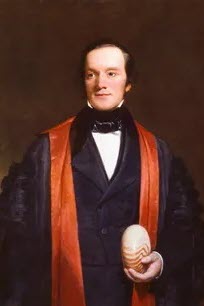
Sir Richard Owen was a prominent scientist (biologist, comparative anatomist and paleontologist) at the time. He would later be the driving force behind the establishment of the British Museum of Natural History in London. Owen was an outspoken critic of Darwin’s theory of evolution by natural selection and vehemently contested the idea that a blind process like natural selection could produce new species. He predicted that “the whole subject would be forgotten in ten years”.
Another influential scientist at the time was Samuel Wilberforce. (He was the son of William Wilberforce, who is well known as a leading voice against the slave trade in Britain.)
He was the Anglican Bishop of Oxford, then later of Winchester. Don’t picture him as “Mr. Collins”, the vicar in Pride and Prejudice. Wilberforce was well educated. He attended Oxford University, taking a First in mathematics and a Second in classics, and he was active and influential in both theological and scientific fields.
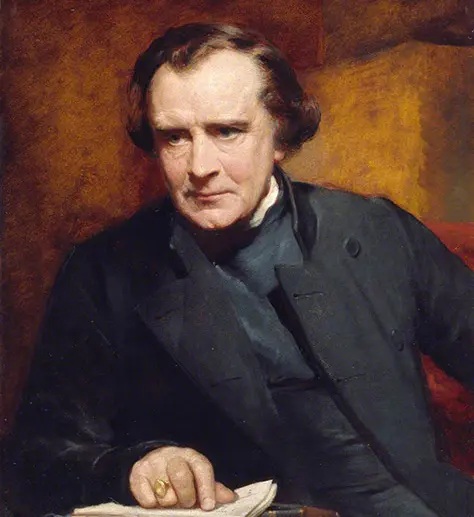
Wilberforce wrote a lengthy review of Origin and later took part in a debate with Thomas Huxley (known as Darwin’s bulldog) at Oxford. He held that what Darwin needed to show was first, that nature possesses a power capable of accumulating favorable variations and second, that it could result in the production of entirely new species. And on those points, Darwin had failed.
He criticized Darwin’s emphasis on pigeon breeding and artificial selection:
“With all the change wrought in appearance, with all the apparent variation in manners, there is not the faintest beginning of any such change in what that great comparative anatomist, Professor Owen, calls ‘the characteristics of the skeleton or other parts of the frame upon which specific differences are founded.”
Wilberforce thought it was nonsense to depend on an analogy between artificial and natural selection, since artificial selection had never come close to creating a new species. His critique continued:
“We think it difficult to find a theory fuller of assumptions; and of assumptions not grounded upon alleged facts in nature, but which are absolutely opposed to all the facts we have been able to observe.”
Further, Wilberforce asked, if natural selection is continually producing innumerable variations, where is the evidence for this in the geological record?
Zoologist St. George Mivart was a leading science professor who also dismissed Darwin’s theory. As a zoologist, he opposed Darwin’s inference that similarities in physiological structure necessarily implied a common ancestor.
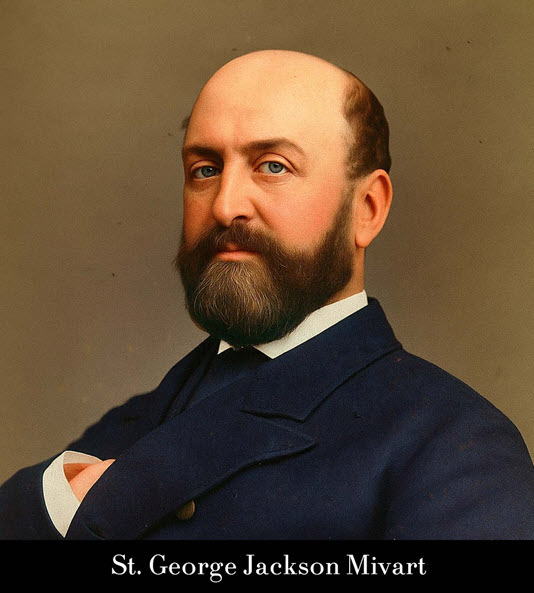
In his 1871 book On the Genesis of Species, Mivart explained that such an inference involved circular reasoning. Similarities of bodily structure were assumed to be indications of common descent without actual evidence; then those similar structures were taken as evidence of common descent.
W. C. Wilson of Dickinson College asked the question: “Has Mr. Darwin furnished one instance of a new species produced by natural selection?” Then, referring to Darwin’s famous bear-to-whale example he asks: “… how much credulity is necessary to enable one to adopt such stories as proofs of a scientific theory.”
Whitwell Elwin, editor of the Quarterly Review, was asked by Darwin’s publisher to vet his manuscript in advance of possible publication. He advised against publication on the grounds that he considered the work “a wild and foolish piece of imagination whose author would have been better advised to confine himself to the subject of pigeons.”
Finally, the French Academy of Sciences stated that Darwin’s case for evolution was “not science, but a mass of assertions and absolutely gratuitous hypotheses, often evidently fallacious. This kind of publication and these theories are a bad example which a body that respects itself cannot encourage.”
Nevertheless, there were many others, of a materialist mindset, who wanted to be rid of authority. They eagerly adopted Darwinism and they won the day. I like the way that Neil Thomas summarizes the situation:
“And so it was that Darwin’s unheralded announcement of a process in which chance variations introduced all the creative steps leading to the whole panoply of terrestrial life struck many in Victorian England as counterintuitive at best. The idea that random variations (today understood as genetic mutations) lay at the root of a process that gave rise to the most intricate of designs was sharply opposed by eminent scientific figures such as Darwin’s accomplished Cambridge tutor William Whewell and leading British scientist Sir John Herschel, the latter of whom reportedly described Darwin’s chance-dependent theory as “the law of higgledy-pigglety.” Thomas, Neil. False Messiah: Darwinism as the God That Failed (p. 24)
Recommended Books:

False Messiah: Darwinism as the God That Failed by Neil Thomas
Darwin’s Bluff: The Mystery of the Book Darwin Never Finished by Robert Shedinger