Life itself is the most miraculous thing in all of God’s creation.
And the LORD God formed man of the dust of the ground, and breathed into his nostrils the breath of life; and man became a living soul.
Genesis 2:7
On the sixth day of creation, God did something unique and new. We’re given a picture of God reaching down into the soil and forming a man with his hands. Then he “breathed into man’s nostrils the breath of life and man became a living soul”. Forming us with his hands from soil implies something more personal, more important, more special than the rest of creation. We’re the only living things made in God’s own image, assembled personally by God’s own hands, with an eternal soul, breathed into us by God.
God made Adam from the materials of the earth that God had created. But when God breathed the breath of life into Adam, he became a living soul. God’s breath isn’t material, since God is spirit, not material. Our souls aren’t made from anything found on earth. Our souls include our minds, wills, and emotions, none of which is material, or even tangible.
Imago Dei – Made in God’s Image
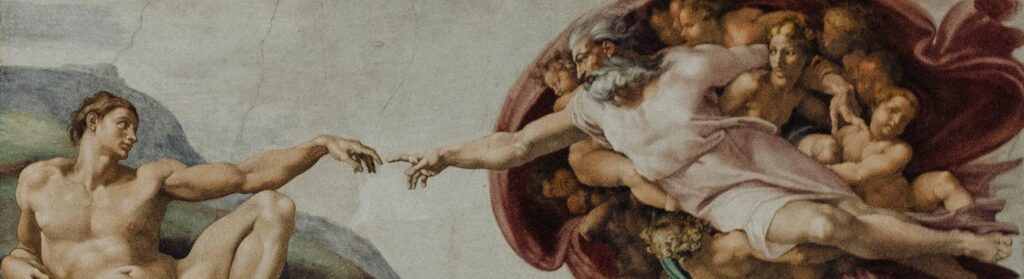
We’re made in the image and likeness of God for a purpose. We have the unique opportunity to meet God – to return his love, worship him, serve him, and fellowship with him. This isn’t true for anything else God created. St. Athanasius wrote in his short treatise On the Incarnation that the chance to know our Maker provides the only way for us to have a genuinely happy and blessed life.
§ 11 “… and why should God have made them at all, if he had not intended them to know him? But, in fact, the good God has given them a share in his own Image, that is, in our Lord Jesus Christ, and has made even themselves after the same Image and Likeness. Why? Simply in order that through this gift of Godlikeness in themselves they may be able to perceive the Image Absolute, that is the Word himself, and through him to apprehend the Father; which knowledge of their Maker is for men the only really happy and blessed life.”
Athanasius, Saint. On The Incarnation (p. 12)
Hebrew scholar Dr. Michael Heiser says that Hebrew grammar is the key to understanding what it means to be made “in God’s image”. In English, the preposition ‘in’ usually refers to location, but it can carry many other ideas. It is the same in Hebrew.
If I say, “I work in education,” I am using the preposition to denote that I work as a teacher or principal, or in some other educational capacity.
This last example directs us to what the Hebrew preposition translated ‘in’ means in Genesis 1:26. Humankind was created as God’s image. If we think of imaging as a verb or function, that translation makes sense. We are created to image God, to be his imagers. It is what we are by definition. The image is not an ability we have, but a status. We are God’s representatives on earth.
Heiser, Michael S. The Unseen Realm (p. 49)
Thinking in terms of representing God on Earth sends my thoughts in new directions. What are the things people are uniquely able to do that could represent God on earth in ways that no other animals can do?
We can love and be loved. We invent and create. We desire justice. And we’re made for communication. All these things lead to joy – delight that’s independent of our circumstances.
God has equipped us in special ways for this calling with abilities that are unique to us and different from the rest of creation.
We can love and be loved:
God created us to love and be loved, and he gave us free will to make it possible. I’m convinced that free will is one of the most complex things God created.
He gave us a full range of emotions, along with distinctive abilities to express them. Our faces use more than 40 different muscle groups to create more than 10,000 unique expressions. Our eyes are framed by white sclera, which expands our range of expression even more. Animals don’t have any of that.
Love begins with families. Our families create joy, bring us joy, and prepare us to be adopted into God’s own family.
We’re made to invent and create:
God gave us a unique ability to be creative. We create art, music, dance, literature, poetry, cooking, sports and games, and more. Even though work can be a chore at times, it’s also often creative.
Our creativity depends on many of the special abilities God gave us. Our thought processes can associate both related and unrelated things from which new inventions emerge. Our coordination and elegance make us fit for dance, music, and art. Walking upright on two legs is an important factor, since it frees our hands. We have an enormous library of muscle memory available for music, language, dance, and sports. Our hands are capable of intricate, detailed tasks.
We’re also made with an innate appreciation of beauty. Combined with our abilities to invent and create, we enjoy crafting beauty wherever we can, enhancing the beauty of creation.
We desire justice:
We have a built-in moral sense of right and wrong, and a conscience to enforce it. In Mere Christianity, C.S. Lewis calls this the Law of Human Nature – the sense of fair play or decent behavior that we all agree on. The difference between this and the law of gravity is that humans can’t choose to ignore gravity like they can decent behavior. Even when we have trouble keeping the golden rule ourselves, we’re instantly aware when someone else isn’t keeping it.
Our mission to promote justice and resist evil is built-in and universal. That includes our need to turn chaos into order wherever we find it. Every society creates rules and authorities to avoid chaos. We train doctors and nurses, and we build hospitals, in our desire to resist disease. We train police and lawyers to resist crime.
We’re made for communication:
We have the ability to compose thoughts into language, building sentences from a huge number of words in our vocabulary, following rules for syntax and grammar. It all happens quickly and unconsciously.
Speaking needs the coordinated actions of approximately 100 muscles in our larynx, mouth, lips, tongue, throat, face, and respiratory system. They all work together to produce sounds accurate enough to be understood. We process the sounds we hear into words and sentences. Our brains are equipped to turn them instantly into facts, thoughts, and ideas.
God made us in his image with inborn abilities that point us toward exactly what he intended for us to be. We’re here to represent God with love, justice, and creativity.