How is the World Reacting to Intelligent Design?
How is the world reacting to this new framework for understanding scientific evidence? Our culture isn’t ready to give up materialism or its evolution myth, and most scientists aren’t either. Their attachment to materialism is as strong as ever.
We need to define materialism before we go on. It doesn’t just mean we like nice things. It’s the philosophical belief that the material world is the only reality that exists.
Richard Lewontin was an evolutionary biologist at Harvard until he passed away in 2021. Here’s a well-known quote from him:
“Our willingness to accept scientific claims that are against common sense is the key to an understanding of the real struggle between science and the supernatural. We take the side of science in spite of the patent absurdity of some of its constructs … in spite of the tolerance of the scientific community for unsubstantiated just-so stories, …”
Everything he said sounds like enough reason to leave evolution behind, move on, and continue searching:
- scientific claims that are against common sense
- patently absurd scientific constructs
- unsubstantiated Just-So stories
By the way, if you’re not familiar with the term Just-So Stories, it’s a book written by Rudyard Kipling to read to his daughter when he was tucking her in. Just-So Stories are filled with entertaining nonsense.
But Lewontin couldn’t move on and keep searching. Here’s the rest of his quote:
“ … because we have a prior commitment, a commitment to materialism. … Moreover, that materialism is absolute, for we cannot allow a Divine Foot in the door.”
Richard Lewontin, Evolutionary Biologist, Harvard
It isn’t science that’s driving Darwinists’ materialism. It’s their devotion to materialism that’s driving their science. Lewontin was honest enough to admit it.
And How is our Culture Reacting?
Here’s a quote from philosopher Thomas Nagel. He was Professor of Philosophy at NYU from 1980 until he retired in 2016. He wrote this in 1980, and he hasn’t changed his mind yet.
“I want atheism to be true and am made uneasy by the fact that some of the most intelligent and well-informed people I know are religious believers. It isn’t just that I don’t believe in God and, naturally, hope that I’m right in my belief. It’s that I hope there is no God! I don’t want there to be a God; I don’t want the universe to be like that …
… My guess is that this cosmic authority problem is not a rare condition and it is responsible for much of the scientism and reductionism of our time. One of the tendencies it supports is the ludicrous overuse of evolutionary biology to explain everything about life, including everything about the human mind. Darwin enabled modern secular culture to heave a great collective sigh of relief, by apparently providing a way to eliminate purpose, meaning and design as fundamental features of the world.”
Thomas Nagel, atheist philosopher, The Last Word, pp. 130–131
Nagle has put his finger on the effect Darwinian evolution has had on our culture. He states that Darwin “apparently provided a way to eliminate purpose, meaning and design as fundamental features of the world.”
But for the past 40 years, ID has continually shown us that purpose, meaning and design really are fundamental features of the world. You saw that in the videos of molecular machines we started with tonight.
Worldviews
Both Lewontin and Nagle reflected their worldviews; science had nothing to do with either of their statements…
Everyone has a worldview. It’s the framework we use to organize our deep beliefs about reality. A worldview addresses essential questions, starting with:
Where did I come from?
Why am I here?
Even if we’ve never consciously thought about those questions, we’re all living out our answers to them.
There have always been just two possible foundations for our worldviews:
- Nature is just an accident
- Nature is the work of a Creator
The first is called materialism. It’s the philosophical belief that the material world is the only reality that exists. Since the Enlightenment in the 1700’s, many scientists have thought their duty was to explain all phenomena without any reference to God, or even a designing intelligence.
- The materialist believes we live in a godless world without purpose.
The second foundation is theistic – the belief that nature had its origin in a preexisting, reasoning mind, in a Creator.
- The theist believes we’re living in a universe created by God for a purpose.
Purpose
That foundation will affect everything else you think, say, or do. What we believe about our world necessarily frames the way we interpret scientific facts. Looking at the very same scientific information through the lens of their worldview, materialists and theists will reach different conclusions.
Materialism can’t accept purpose or meaning. Yet scientific discoveries keep accumulating that practically scream “Purpose!”
Our culture doesn’t treat the two worldviews equally. Materialists hold the default position, so they’re considered open-minded. Theists, however, are perceived to have a religious agenda.
So, when a materialist says there is no scientific evidence for God, our culture accepts that at face value – they’re viewed as open-minded with no agenda. But when we recognize that a scientific discovery points to God’s hand in creation, our culture thinks that’s just our religion talking, so we’re dismissed.
Adopting a Worldview
So how do we acquire our worldviews? For most of us, it happens in the background while we’re busy living our lives. Lots of things bypass our thought processes but still influence our worldviews.
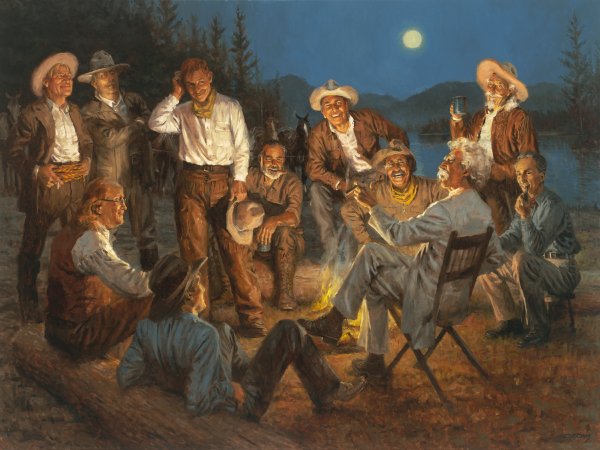
People are storytellers by nature, so stories are powerful influences on our worldview. Stories, or word pictures, give us ways to frame and organize our thoughts, experiences, and knowledge. They form lasting pictures in our minds that help us bring concepts to life.
Ideas that are part of a compelling story can capture our imaginations and plant seeds that grow into our beliefs. This is true whether the story is true or not.
Evolution is one of the stories we hear over and over as we’re growing up. Our culture insists that Darwinian evolution is an undeniable fact. From childhood on, we absorb the evolution story – from National Geographic, PBS, schools and textbooks, teachers and professors, museums, and more. Evolution has grown such deep roots into our culture that we mistake familiarity for truth.
Evolution by natural selection is an easy concept to grasp. As soon as you hear it, it seems intuitively obvious. We’re likely to think, “Of course! Why didn’t I think of that!”
Evolutionist and outspoken atheist Richard Dawkins is a better storyteller than I am, so I’ll let him tell the evolution story:
“Given enough generations, ancestors that look like newts can change into descendants that look like frogs. Given even more generations, ancestors that look like fish can change into descendants that look like monkeys. Given yet more generations, ancestors that look like bacteria can change into descendants that look like humans. And this is exactly what happened.”
The Magic of Reality, by Richard Dawkins, page 30.
It’s a good story, but that isn’t exactly what happened, and science now proves that it isn’t. By the way, that’s the level of proof you’ll find in all of Dawkins’ work.
Simple answers like evolution are especially attractive because they let us think we understand more about the world than we actually do. But simplicity doesn’t make it true, even though it makes a very appealing story that’s hard to ignore.
How did Evolution become Our Creation Myth?
During the “enlightenment” period, materialism got a foothold. By the time Darwin published Origin of Species, materialism was already the dominant worldview in Europe. This probably had a lot to do with how readily Origin was accepted.
Design without a Designer
When he published Origin, Darwin offered a designed world “without a Designer”. For materialists, this seemed to bring the question out of the realm of religion and philosophy and into the world of science. And they jumped for it. But not because Darwin’s “science” was convincing. The leading scientists of the day either criticized it harshly or dismissed it as nonsense that would soon be forgotten. It was accepted by materialists for philosophical reasons.

Evolution and natural selection are easy concepts to generalize. People found they could explain almost anything about human nature by appealing to a story about our supposed “evolutionary journey”. As a result, evolution soon found its way into most of the social sciences like sociology, psychology, economics, political science, and anthropology. This has secured Darwinism’s place in the culture.
So today, materialism remains the dominant worldview in our culture, and Darwinian evolution is our creation myth. It’s been this way for more than one hundred years…