In 1959, if you believed in God, it was in spite of what science told you…
That year the Darwin Centennial Celebration was held at the University of Chicago to celebrate the 100th anniversary of Origin of Species. It attracted leading evolutionists from all over the world. After one panel discussion, Harvard Professor Harlow Shapley summarized it:
“We pointed out that Darwinian evolution is not a theory anymore but a fact.”
That’s gives you a window into what our culture in general thought at the time. Darwinists thought they had the world on a string. They were confident they had already explained evolution, and there were just some details left to fill in.

The structure of DNA had been unraveled only recently, and it seemed to confirm their assumption that mutations were the mechanism behind Darwin’s “variations”.
Miller and Urey’s famous “origin of life” experiment had made some amino acids in the lab with sparks and methane, so evolutionists thought making a living cell was going to be easy.
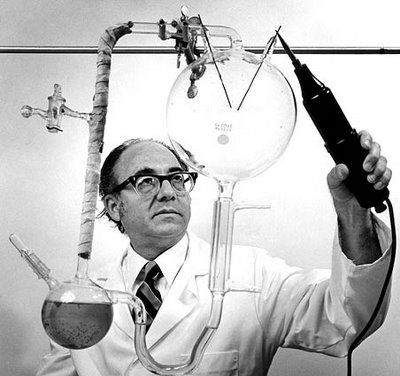
At the Centennial, Professor Shapley referred to the Miller-Urey experiment, and told a television audience that:
“…the most difficult test of all has been met.”
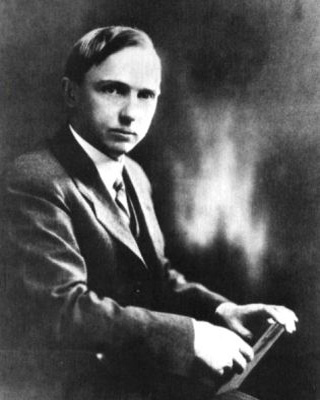
Then he told the audience that this experiment had supplied proof of what scientists had long suspected:
“…the appearance of life is essentially an automatic biochemical development that comes along naturally when physical conditions are right.”
Good grief. There is so much wrong with that statement. You can admire Shapley’s optimism; but to claim that an experiment that only formed a few amino acids had practically solved the problem of the origin of life was just nonsense. He was counting on the credulity of his audience.
But that was in 1959, and parts of biology hadn’t yet left 19th century science behind.
- Living cells were still a mystery.
- Life was still a “chemical phenomenon” – if they could just mix the right chemicals together, life would result. Making life in the lab was just around the corner!
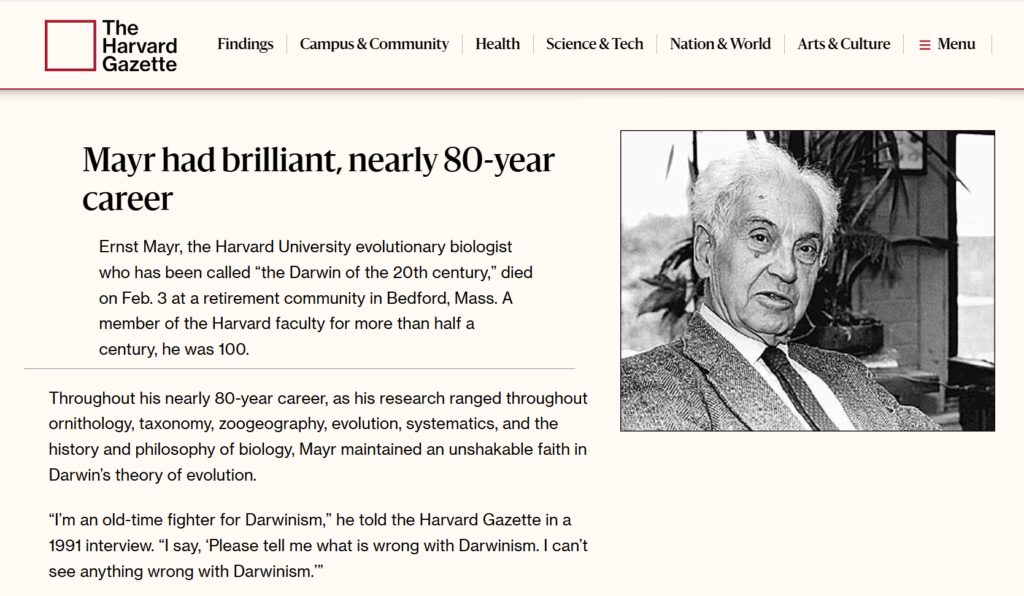
A few years ago, I was lucky enough to find a short film clip from a panel discussion at the Darwin Centennial. The panel included Ernst Mayr, one of the 20th century’s leading evolutionary biologists. He was a member of the Harvard faculty for more than 50 years and one of the leaders in the development of Neo-Darwinism. He’s been referred to as the “Darwin of the 20th century.”
Mayr was a good storyteller; and this is a good introduction to “Just-So” stories.
- It included causes and effects, which made it sound more scientific, but they’re all imaginary.
- He also gave natural selection credit for thinking, just like we think – attributing effects to plausible causes. That’s called personification, and Darwinists use it a lot.
But it’s fiction… His stories were grounded in 19th century science. In reality:
- Living organisms aren’t molded by cause and effect. Natural selection can’t nudge an animal to develop lungs no matter how much we think they’re needed.
- Selection pressure is an imaginary construct used by evolutionists to cover up gaps in their knowledge.
- Mayr acknowledges the need for “the necessary gene combinations” to appear. But he makes that sound easy – they simply “appear”, as if on cue.
Mayr seems completely unaware of how many collateral changes would be required to add lungs.
- You need new instructions and genes for new tissue types.
- You need new instructions for building lungs.
- The blood circulation system has to be redesigned to route blood through lungs.
- The entire pharynx and swallowing process has to be redesigned, to route air to the lungs and foods to the digestive system.
The embryonic process is meticulously orchestrated. It would need to be entirely rewritten to incorporate lungs into the design. And my list only scratches the surface of the number of collateral changes involved.
In 1959, Mayr couldn’t have known that mutations are overwhelmingly more likely to damage and degrade an existing gene than to create a brand-new one. We know that now…
The trillions of cells in our bodies divide many times during our lifetime. Even though the mutation rate is very low, mutations add up. We call it … aging. By the time you die of old age, your body will have accumulated billions of mutated cells. Not one of them will have done you any good at all.

We also know that mutations lead to cancer, which often leads to death. In the real world, mutations are never helpful.
And they also aren’t creative. The probability of creating even one new gene or one new protein by accidental mutation is so low, it’s unlikely to have happened even once since planet Earth was formed.
Mayr’s Misdirection
In 1959, Mayr could brush away the single most important fact with a casual:
“When the necessary genes combinations appear” statement.
This was a classic case of misdirection, just like magician use. But there’s a lot hiding in that throw-away line. Even in 1959, he was aware that anatomical changes are downstream from genetic changes. Nothing Mayr imagined could happen without new genes and new building instructions. And we’re not talking about a handful of changes. It would require at least tens of thousands of carefully coordinated changes to the genome to produce his air-breathing fish.
All those changes would have to be integrated into embryonic development at the earliest stages, when the structural features of the body plan are established. And they all have to happen at once. Yet hundreds of experiments done since 1959 have proven that:
Mutations that affect portions of the genome involved in the early stages of development of an embryo are invariably fatal.
The truth that everybody knows now is that Mayr’s “necessary gene combinations” aren’t going to appear, ever. It would be way beyond the limits of chance. Embryonic development is just too complex and too carefully orchestrated to allow tinkering.
Like we all tend to do, Mayr took for granted what he didn’t understand, and assumed that it must be simple. His story didn’t contain any truth, but it was enough to convince his audience. He was voted one of the world’s 100 most influential scientists in 1996.